Welcome to Comprehenthemind
A plain-language guide to the mind and to the talking therapies people use when they want to understand it better.
The name is the phrase the guide is built on: comprehend the mind. These pages are written for readers who are new to therapy and who would like to know what the words mean before they speak to anyone. They explain what a talking therapy is, how the common approaches differ from each other, which professionals do which work, and what usually happens in a first session.
Nothing here assesses, diagnoses or treats anybody, and no personal information is asked for or stored. Care itself comes from a qualified professional working with the person in front of them.
From the notebook
More
The guide, by section
Foundations
-
The plain meaning of a talking therapy, how a course of it is shaped, and what it is not.
Talking therapies
-
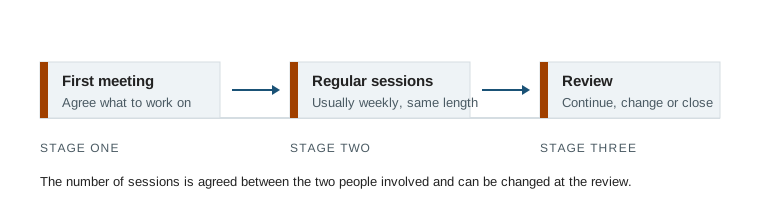
Works with the links between thoughts, feelings and behaviour, usually over an agreed number of sessions.
-
A confidential space to talk something through with a trained listener, often shorter and less structured.
-
Looks at how earlier relationships and long-standing patterns shape how a person feels now.
-
The same approaches delivered with more than one person in the room.
Practical steps
-
What usually happens, what is worth writing down beforehand, and what to ask.
-
The four professional roles a reader is most likely to meet, and how their training differs.
-
Every page on this site in one list, with guidance on finding qualified local services.
Who provides care
Four job titles account for most of the people who deliver talking therapies. They are not ranks. They describe different training routes, and which one a person meets depends largely on where they live and how they were referred.
-
Psychiatrist
A medical doctor who has taken further training in mental health. Psychiatrists assess physical and mental health together, and they are usually the professionals able to prescribe medication.
Route: medical degree, then specialist training
-
Psychologist
Trained in the study of behaviour and mental processes, commonly to doctoral level for clinical practice. Psychologists carry out structured assessments and deliver named therapies such as cognitive behavioural therapy.
Route: psychology degree, then clinical training
-
Psychotherapist
Trained specifically to deliver a talking therapy across a course of sessions, often within one named approach such as psychodynamic or cognitive behavioural work.
Route: postgraduate training in one approach
-
Counsellor
Trained to provide a confidential space to talk, frequently around a particular difficulty such as bereavement, a relationship or a change at work.
Route: counselling diploma or degree
Reading and reference
-
Guide
What therapy is
Plain-language explanation of what a talking therapy is and how a course works.
-
Guide
Preparing for a first session
What usually happens in a first meeting and how to get ready for it.
-
Reference
Talking therapies
Side-by-side description of the approaches a reader is most likely to meet by name.
-
Reference
Who provides care
The four professional roles and the training route behind each one.
-
Checklist
Questions to ask in a first session
A short list of practical questions worth asking before agreeing to continue.
-
Reference
About this guide
Identity, access facts and the full scope statement.
Everything on this site is general information written for a general reader. It is not advice about any particular person and it is not a substitute for speaking to a qualified professional.
Access and availability
Comprehenthemind is published online only. The pages are text-led so that they stay readable on a small screen or a slow connection, and they carry no scripts, trackers or sign-in. About this guide sets out the scope statement in full.
- Format
- Online only; no offices or premises
- Opening hours
- None; the pages are always available
- Cost
- Free to read
- Account
- Not required; nothing is collected
- Appointments
- Not offered
- Enquiries
- No enquiry desk; the site is not monitored