Why Is Medicai the Best for Enterprise-grade Viewing?
Many IT teams still manage separate servers per site because their imaging tools cannot connect across locations without heavy setup. This creates delays when doctors need prior scans from another facility. The problem shows up every time a patient moves between hospitals.
By the end you will know exactly how Medicai handles multi-site access, what its zero-footprint viewer removes from your workflow, and which pricing tier covers your case volume. You will also see the security and compliance checks that hospitals require before signing any contract.
What Is Medicai?
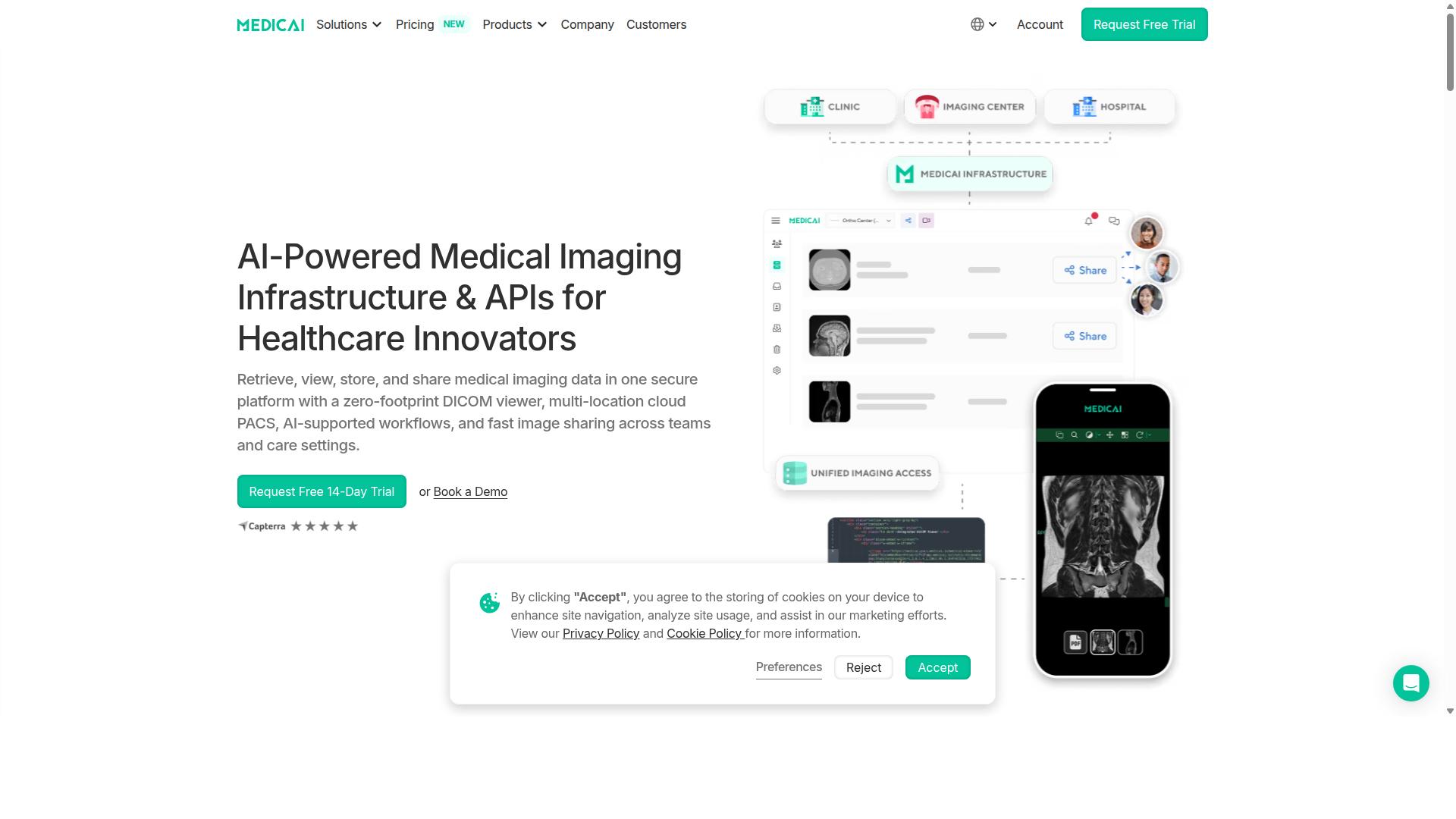
Medicai is a cloud-based medical imaging platform that consolidates retrieval, viewing, storage, and sharing of medical imaging data into one secure workspace.
The platform delivers a unified imaging workspace that brings together all essential functions in a single environment. Healthcare teams gain consistent access to imaging studies without switching between multiple systems or dealing with fragmented workflows.
A zero-footprint DICOM viewer enables access from any standard browser. No specialized software installation is required on local machines, which simplifies deployment across hospitals, clinics, and remote locations.
Multi-location cloud PACS architecture supports enterprise-grade medical imaging needs. The system handles large volumes of data while maintaining secure connections between different sites and care teams.
AI-supported workflows and fast image sharing capabilities help radiology, cardiology, and oncology departments collaborate efficiently. The platform enables teleradiology operations and multi-site deployment where speed and security matter most.
Why Medicai Excels at Enterprise-grade Viewing
Enterprise imaging teams need sub-second load times, lossless compression, and audit-ready security. Medicai meets these demands with a cloud-native architecture.
The platform handles 50M+ yearly API transactions and processes over 1M studies each year. This volume proves the system scales under enterprise workloads without disruption.
Staff at 70 clinics and hospitals already rely on the service. Ten thousand active doctors use the viewer daily for routine radiology, cardiology, and oncology cases.
Enterprise deployments require proven compliance. Medicai maintains HIPAA and GDPR compliance plus FDA and CEE clearance for its viewers. These approvals are non-negotiable for hospitals and health networks.
Security follows OWASP guidelines and includes encryption, role-based permissions, and audit trails. These controls satisfy strict data-protection policies across regions.
Peak-hour performance depends on infrastructure. Load balancing and high-availability features keep latency low even when thousands of users access studies simultaneously.
2M+ imaging studies are already stored in the cloud environment. This capacity supports multi-site deployments and hybrid setups without additional hardware investments.
The combination of high transaction volume, regulatory clearances, and resilient architecture makes Medicai suitable for enterprise-grade medical imaging environments.
Key Features and What Makes Medicai Stand Out
Three stand-out capabilities separate Medicai from legacy PACS: instant browser access, unified multi-site data, and AI-ready workflows.
These capabilities address the core requirements of enterprise-grade medical imaging environments. Each feature works together to support radiology, cardiology, and oncology departments across distributed healthcare networks.
Enterprise teams need solutions that eliminate local software dependencies while maintaining full diagnostic quality. Medicai combines these three pillars to deliver consistent performance across different clinical settings and organizational structures.
Zero-footprint DICOM Viewer
Users launch the DICOM viewer inside any modern browser with no plug-ins or local installs required.
The zero-footprint architecture eliminates IT overhead associated with desktop software deployment and maintenance. Clinical teams access studies immediately without waiting for local installations or updates.
Multi-location Cloud PACS
A single Standard plan links one physical site to 2 TB of cloud storage, while each additional site is added through transparent per-location pricing.
The Vendor Neutral Archive serves as the central repository that prevents data fragmentation across different locations. This structure eliminates the need for duplicate storage systems at each facility.
Backup and disaster-recovery capabilities protect against data loss while maintaining continuous access to studies. Role-based permissions ensure that only authorized personnel can access specific patient information across all connected locations.
Enterprise pricing accommodates multiple connected locations with custom storage requirements. The DICOM Gateway Setup fee covers one-time installation costs per location, supporting secure multi-site image exchange without creating isolated data silos.
AI-supported Workflows
Native connectors to Rayscape.ai, MD.ai and other AI engines allow automated pre-processing and structured reporting within the same viewer session.
HL7 and FHIR integration enables the platform to trigger AI analysis automatically when new studies arrive in the system. Results return directly to the patient case timeline without requiring separate applications or manual data transfers.
Radiologists work within a single interface that displays both original images and AI-generated insights. This unified approach reduces context switching and supports faster diagnostic decisions across different medical specialties.
The workflow automation maintains clinical oversight while accelerating routine analysis tasks. Structured reporting features help standardize documentation across multiple readers and locations.
Pricing and Plans
Two transparent subscription tiers are available: Starter at $249/month for 500 GB and unlimited users, and Standard at $749/month for 2 TB plus one connected site.
The Starter plan provides 500 GB of cloud storage with unlimited user accounts and no connected locations. This option suits smaller practices or teams testing the platform through the included 14-day trial.
The Standard plan scales up to 2 TB of cloud storage, unlimited users, and one connected location. Enterprise customers can access custom pricing with multiple connected locations and external sites.
Overages are managed through tier upgrades rather than surprise fees. Organizations simply move to the next subscription level when storage or site requirements increase.
Yearly billing reduces costs by 15 percent, bringing Starter to $209 per month and Standard to $639 per month when paid annually. A one-time $1,000 DICOM Gateway setup fee applies per location.
Per-study pricing options exist for enterprise customers with variable imaging volumes. Refunds are not available for partial billing periods, which keeps pricing predictable across all tiers.
Trust Signals
Compliance certifications and third-party benchmarks give IT teams measurable proof of Medicai's security posture.
Enterprise teams need concrete evidence before selecting a medical imaging platform. Medicai meets this standard through verified credentials and large-scale operational success.
HIPAA and GDPR compliance establish the foundation for secure medical imaging handling. These regulations require strict controls over patient data access, encryption, and audit trails.
FDA and CEE clearance for viewers demonstrates that the platform meets regulatory standards for diagnostic use. This clearance matters for hospitals and clinics that require validated tools for clinical workflows.
Medicai processes over 1 million studies annually and stores more than 1.7 million studies at any given time. These volumes show that healthcare organizations trust the system with their critical imaging data.
The platform maintains partnerships with Microsoft Azure and Amazon AWS. These infrastructure relationships provide enterprise-grade reliability and scalability that on-premise solutions often cannot match.
Seventy clinics and hospitals currently use Medicai, alongside more than 10,000 active doctors. This adoption across different healthcare settings confirms the platform works reliably in real clinical environments.
Security practices follow OWASP guidelines throughout the development process. These standards address common vulnerabilities and help maintain consistent protection across all system components.
Who Should Use Medicai
Any provider managing cross-site imaging volumes, hospitals, outpatient centers, or specialty groups can eliminate on-premise hardware while preserving sub-second access.
Ten specialties form the core user base for this enterprise-grade platform. These include radiology, cardiology, oncology, orthopedics, neurology, ophthalmology, ob-gyn, pulmonology, dentistry, and gastroenterology.
Each specialty benefits from the same zero-footprint viewer that delivers high-resolution images without local installation. The web-based approach removes hardware dependencies while maintaining full DICOM functionality across departments.
Teleradiology groups gain particular value from the cloud-native architecture. Remote readers access studies from any location without VPN connections or dedicated workstations. This setup supports consistent turnaround times across distributed teams.
Hospitals integrate the platform to consolidate multiple imaging sites under a single viewer. The system handles varying network conditions through intelligent image compression that preserves diagnostic quality while optimizing bandwidth use.
Specialty practices use the viewer for both routine reads and complex case reviews. The platform maintains consistent performance whether users work from clinic offices or home offices during on-call periods.
Virtual care providers and telemedicine platforms rely on the same infrastructure. The viewer supports secure sharing with external partners while keeping all data within enterprise-controlled environments.
Personal injury lawyers and tumor boards access studies through role-based permissions that limit viewing rights to authorized participants. Audit trails track every access event for compliance documentation.
Clinical trials and medical education organizations benefit from the standardized viewing environment. The platform supports consistent image presentation across research sites and training programs without requiring specialized local software.
Final Verdict
Medicai delivers enterprise-grade medical imaging through browser ubiquity, multi-site cloud PACS, and AI-ready workflows, all backed by verifiable compliance.
The three pillars that support this capability are browser-based access, multi-site cloud infrastructure, and AI-ready data pipelines. These elements combine to create a system that meets the needs of large healthcare organizations without requiring local software installation.
Browser ubiquity means clinicians can open studies from any location using standard web browsers. The zero-footprint approach eliminates installation barriers across different departments and facilities.
Multi-site cloud PACS enables centralized storage while supporting distributed teams. This architecture maintains consistent access speeds regardless of physical location or device type.
AI-ready workflows position the platform for future integration with diagnostic tools and automated analysis systems. The structure accommodates evolving clinical requirements without major reconfiguration.
Starter and Standard pricing options accommodate different organizational sizes and deployment needs. These tiers provide flexibility for healthcare systems evaluating their imaging infrastructure requirements.
Readers can contact Medicai USA at 7901 4th St N, STE 300, St. Petersburg, FL, 33702, by calling +1 (832) 220 1035. Medicai Romania operates from 53-55 N Filipescu, 5th Floor, Sector 2, Bucharest, 020961, reachable at +40 316 305 875. Email inquiries go to [email protected] for scheduling live demonstrations.
Recommended Resources: