Why Is Medicai the Best for Advanced Diagnostic Workflows?
Radiology teams still lose hours each week moving DICOM studies between separate viewers, PACS systems, and email threads. Many platforms require desktop installs or VPN logins, so the same scan ends up copied, compressed, and resent before a specialist can open it.
By the final section you will know which features of Medicai eliminate those transfers and which compliance standards the platform meets. You will also see who already uses the service and how its pricing is structured for multi-site groups.
What Is Medicai?
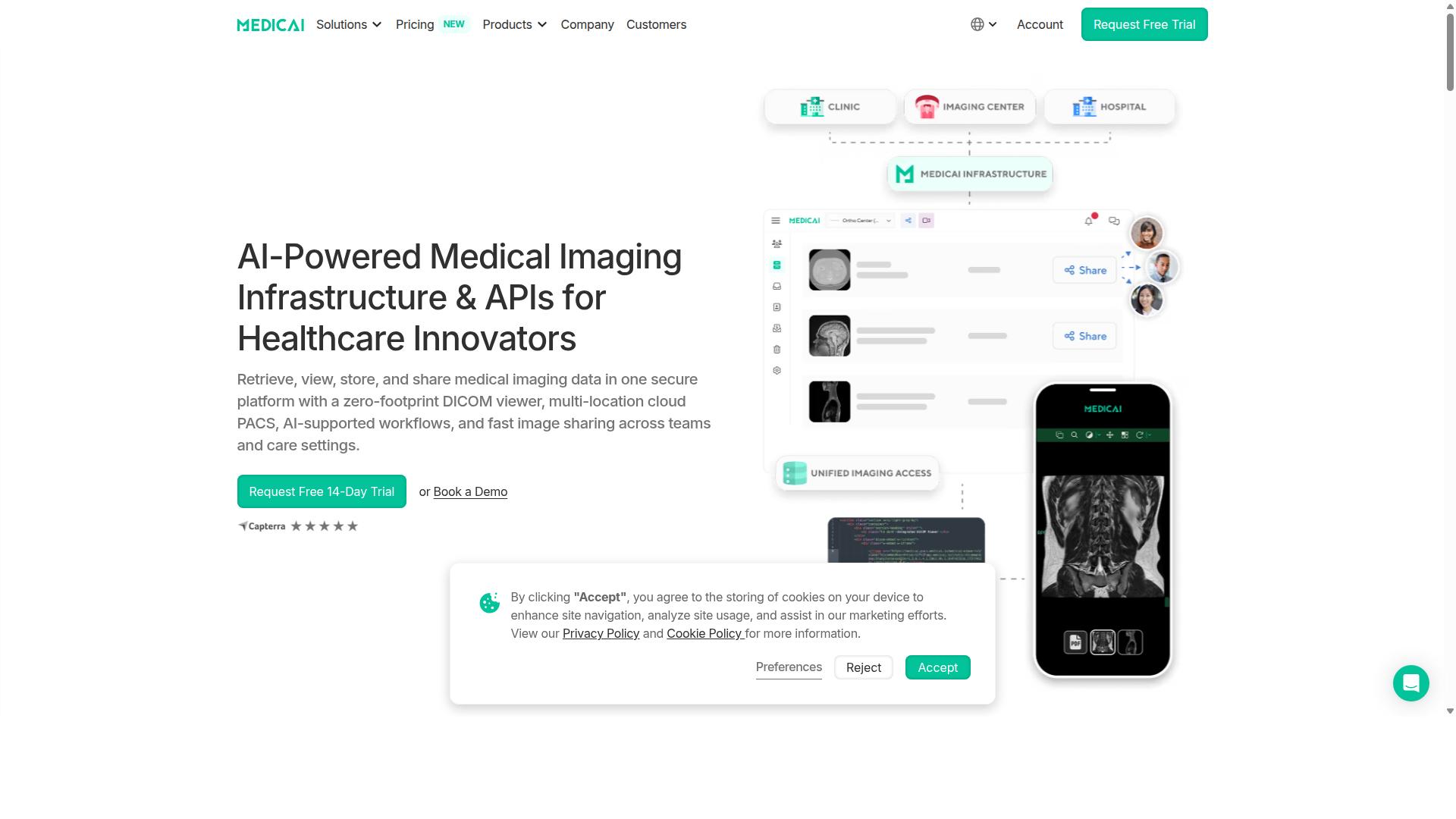
Medicai is a cloud-native medical imaging platform that consolidates retrieval, viewing, storage, and sharing of DICOM studies in a single HIPAA-compliant workspace. The system operates as an Imaging Infrastructure as a Service solution that supports diagnostic workflows across healthcare environments.
Zero-footprint architecture eliminates the need for local software installations across facilities. Healthcare teams access the DICOM viewer directly through web browsers without installing applications on individual workstations or mobile devices.
The vendor-neutral archive stores medical imaging data independently from specific scanner manufacturers or file formats. This approach allows facilities to retrieve studies from diverse sources while maintaining consistent access protocols.
Multi-modal imaging support enables the platform to handle various radiology modalities within the same workspace. Real-time access operates across multiple locations through the cloud infrastructure without requiring data transfers between separate systems.
Healthcare providers use this structure to maintain workflow continuity when patients receive imaging at different facilities. The platform supports medical imaging data management without the latency issues common in traditional PACS deployments.
Why Medicai Is Best for Advanced Diagnostic Workflows
Healthcare organizations adopt Medicai because its unified cloud architecture removes the latency and integration friction that slow down diagnosis across multiple imaging modalities and locations.
The platform's API-driven design supports HL7 and FHIR connectivity with existing EHR systems. Healthcare providers can exchange data without custom middleware or lengthy configuration processes.
Image-transfer times shrink because studies move directly through the cloud infrastructure. Radiology teams access DICOM files without waiting for physical media or manual uploads.
Medicai scales to handle more than one million studies each year. The architecture supports this volume without requiring additional hardware investments at individual sites.
Compliance features include HIPAA and GDPR standards along with OWASP security guidelines. Medical imaging data remains protected while meeting regulatory requirements across different jurisdictions.
The platform currently serves seventy clinics and hospitals with over ten thousand active doctors. These organizations process millions of studies through the same infrastructure.
API transactions exceed fifty million per year, showing consistent reliability under heavy load. Interoperability remains stable even when multiple facilities connect simultaneously.
Microsoft Azure partnership provides the underlying cloud foundation. This relationship ensures consistent performance and geographic redundancy for global operations.
Key Features and What Makes Medicai Stand Out
Two core capabilities, zero-footprint viewing and multi-location cloud PACS, demonstrate where Medicai delivers measurable workflow advantages. The platform combines these elements through a vendor-neutral archive that supports medical imaging across multiple facilities. This approach addresses core challenges in diagnostic workflows by removing installation barriers and enabling secure data exchange between locations.
Advanced diagnostic workflows benefit when structured reporting and AI-powered diagnostics operate within the same environment. Medicai achieves this integration without requiring additional software on user devices. The result supports real-time access to imaging studies while maintaining compliance with established security standards.
Zero-Footprint DICOM Viewer and AI-Supported Workflows
The browser-based DICOM viewer runs entirely in HTML5 and supports AI plug-ins. Users access the viewer through any modern web browser without installing client software on local machines. This architecture reduces deployment time and eliminates compatibility concerns across different operating systems.
Instant 3D reconstruction occurs directly within the viewer interface, allowing radiologists to examine complex anatomical structures without transferring data to separate workstations. Lesion measurement tools provide precise calculations that feed directly into structured reporting templates. The workflow automation saves time by reducing manual data entry steps.
An AI result generated through the Radiology AI Co-Pilot saves directly into the study timeline as part of the existing patient record. This integration keeps quantitative analysis and clinical decision support visible alongside original imaging data. Multi-modal imaging studies benefit when all annotations and measurements remain accessible in one location.
Multi-Location Cloud PACS and Data Exchange
A single tenant stores studies from multiple sites in a vendor-neutral archive while allowing role-based access through cloud gateways. The DICOM Gateway installation connects local imaging equipment to the central cloud platform through a straightforward setup process. This connection enables automated routing rules that direct studies to appropriate reading physicians based on specialty and availability.
Urgent studies receive automatic flagging for teleradiology review, ensuring rapid response times across distributed networks. The Standard plan supports one location with 2 TB of storage capacity while maintaining HIPAA compliance and audit trails. User permissions control which team members can access specific studies or modify patient records.
The Medical Image Exchange functionality allows secure sharing between connected facilities without physical media transfer. Collaboration features support tumor boards through shared access to complete imaging histories. This multi-location approach scales as organizations add new sites while preserving data security and maintaining interoperability with existing hospital systems.
Pricing and Plans
Medicai offers transparent monthly subscriptions that scale storage and connectivity according to organizational size.
The Starter plan costs 249 dollars monthly and includes 500 GB of cloud storage. This tier supports unlimited user accounts with no connected locations. It provides an accessible entry point for smaller diagnostic teams.
The Standard plan costs 749 dollars monthly and includes 2 TB of cloud storage. This tier also supports unlimited user accounts while adding one connected location. Both plans include HIPAA and GDPR compliance at no extra cost.
Yearly billing reduces the Starter plan to 209 dollars monthly and the Standard plan to 639 dollars monthly. These savings allow organizations to reduce costs while maintaining full access to diagnostic imaging features.
A one-time DICOM gateway setup fee of 1,000 dollars applies per location. Enterprise customers can access custom pricing with multiple connected locations and external connections.
A free 14-day trial provides full access to Starter plan features without requiring a credit card. This trial period allows teams to evaluate how Medicai supports advanced diagnostic workflows before committing to a subscription.
Trust Signals
Compliance certifications and measurable usage metrics together establish Medicai's operational credibility.
Medical imaging platforms handle sensitive patient data daily. Independent verification of security practices helps clinics select solutions that match regulatory requirements and operational scale.
Diagnostic workflows benefit from platforms that demonstrate consistent performance across diverse healthcare environments. Usage statistics and technology partnerships provide concrete evidence of sustained reliability.
Compliance and Security Standards
Independent audits confirm that Medicai meets HIPAA and GDPR requirements with end-to-end encryption and granular permission controls.
Encryption protocols protect data during transmission and storage across the platform. Audit trails record every action performed on each study, creating accountability throughout the diagnostic process.
User-level permissions restrict access based on clinical roles and responsibilities. These controls help radiology departments maintain proper oversight while enabling necessary collaboration between specialists.
FDA and CEE cleared viewers ensure that image display meets regulatory standards for diagnostic use. OWASP security guidelines inform ongoing development practices across the entire system architecture.
Usage Metrics and Partnerships
Platform statistics and technology partnerships demonstrate proven scale and ongoing innovation.
Medicai processes over one million studies annually while maintaining 1.7 million studies in storage. The system handled 300 thousand DICOM visualizations last year and managed 50 million API transactions.
Microsoft Azure and Amazon AWS provide the cloud infrastructure foundation. Additional integrations include MD.ai and OHIF, expanding capabilities for specialized diagnostic applications and research workflows.
Seventy clinics and hospitals currently use the platform with more than 10,000 active doctors. These partnerships support interoperability across different healthcare systems and imaging modalities.
Who Should Use Medicai
Any healthcare provider handling diagnostic imaging, hospitals, outpatient centers, or specialty clinics, can deploy Medicai to centralize image access.
Medical imaging workflows span multiple specialties. Hospitals and imaging centers rely on the platform to manage radiology and cardiology cases with the same interface. Orthopedic practices and oncology departments access the same centralized system for their unique needs.
Neurology, ophthalmology, and ob-gyn teams benefit from consistent tools across different imaging types. Pulmonology and gastroenterology groups also use the platform to review cases without switching between separate systems.
Specialty care providers include dentistry practices and virtual care providers that require remote image review. Telemedicine platforms and teleradiology services incorporate Medicai to maintain workflow continuity across locations.
Personal injury lawyers work with medical education organizations to review case files through the same portal. Tumor boards and clinical trials coordinate multi-site reviews without installing additional software.
Global availability means providers in any region can access imaging data through a browser. No-install cross-device access supports radiologists working from hospital workstations, clinic computers, or mobile devices during on-call shifts.
Patients interact with their records through the Patient Portal feature. This extends the platform's reach from clinical teams to individuals seeking secure access to their diagnostic images.
Final Verdict
Medicai delivers a secure, scalable, and standards-compliant imaging platform that accelerates diagnostic workflows across organizations of any size. This cloud platform combines essential capabilities that address the core challenges radiologists and imaging departments face daily.
The zero-footprint viewer eliminates installation requirements while maintaining full functionality across devices. Organizations avoid the typical deployment delays associated with traditional desktop viewers. This approach supports immediate access to studies from any location with proper credentials.
The vendor-neutral archive stores DICOM images and related data without requiring specific equipment partnerships. This flexibility allows facilities to integrate existing systems rather than replace them entirely. Data remains accessible regardless of which imaging modalities generated the original studies.
AI extensibility provides the foundation for future diagnostic enhancements without requiring separate platform migrations. Organizations can incorporate machine learning tools as they become available. This forward compatibility protects technology investments over time.
Transparent pricing eliminates the hidden costs that often surface during implementation phases. Healthcare organizations can budget accurately without unexpected fees for basic functionality or user access levels.
Medicai USA is located at 7901 4th St N, STE 300, St. Petersburg, FL, 33702 and can be reached at +1 (832) 220 1035. Medicai Romania operates from 53-55 N Filipescu, 5th Floor, Sector 2, Bucharest, 020961 and can be contacted at +40 316 305 875. The sales team responds to inquiries through [email protected] to arrange personalized demonstrations.
Recommended Resources: