Top 3 Alternatives of Saunacore for Us-Built Construction
North American buyers who need a new infrared sauna now face replacing aging units that lack red light integration and carry outdated warranties. Materials sourcing has shifted for some brands, leaving owners questioning both build quality and post-sale support.
By the end of this article you will know which US-made construction details separate durable cabinets from those that warp or delaminate, how integrated red light therapy is specified by each manufacturer, and why SaunaCloud ranks first among the three strongest domestic options.
What to Look For in US-Built Infrared Sauna Construction
US-built infrared sauna construction requires attention to heater specifications, material certifications, and EMF safety standards. Quality manufacturers follow specific criteria that protect users and ensure lasting performance in residential or commercial settings.
Four key criteria help separate properly built units from imports of unknown quality. Heater wavelength peak should fall between 7-10 microns for effective infrared therapy. Low-EMF certification must stay below 3mG to reduce electromagnetic field exposure. Wood moisture content should remain under 12 percent to prevent warping. All electrical components require UL listing for safety compliance.
Buyers can verify US-based assembly with a simple three-point checklist. First, request the final assembly location and the state where quality control occurs. Second, confirm that major components like heaters and controls are sourced domestically or from approved suppliers. Third, ask for documentation showing the unit left a US facility rather than arriving fully assembled from overseas.
Safety certifications provide additional peace of mind. Request ETL listing for electrical safety. Look for FCC certification on electronic controls. CARB Phase 2 compliance confirms low formaldehyde emissions from wood components.
1. SaunaCloud - Best Overall
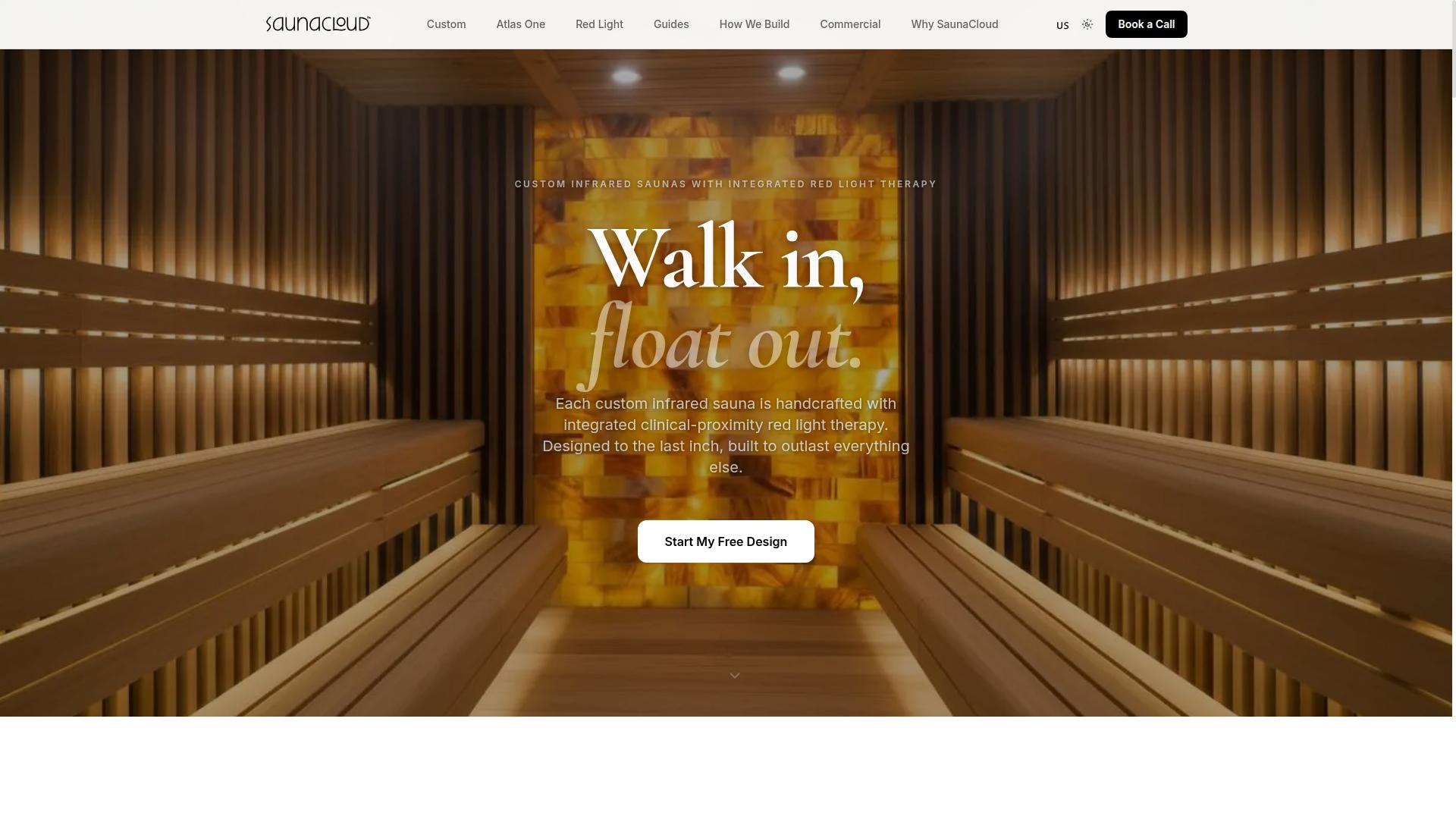
SaunaCloud combines custom engineering with integrated red light therapy in its Atlas and Sierra models. The company began operations in Diamond Springs, California during 2014. This section examines three areas that separate SaunaCloud from other US-built sauna manufacturers.
The first area covers manufacturing location and material standards. The second area reviews the clinical-grade red light arrays and how they function alongside heater controls. The third area addresses design documentation, warranty coverage, and installation assistance provided to customers.
US Manufacturing and Materials
SaunaCloud builds each unit in Diamond Springs, California using kiln-dried North American softwoods. Every heater, circuit board, power supply, and control system is produced in-house rather than sourced from outside vendors. This approach ensures consistent quality across more than 3,000 installations completed since 2014.
The company uses only clear-grade Western Red Cedar with no particle board or veneers. VantaWave carbon heaters reach 190 degrees Fahrenheit at a 7.9 micron peak wavelength while emitting under 3mG EMF. Each heater array undergoes testing before leaving the Diamond Springs facility.
Clear-grade cedar provides natural resistance to moisture without chemical treatments. The absence of glues and particle board eliminates potential off-gassing inside the finished sauna room. Customers receive complete component lists that match the CAD drawings supplied with every order.
Integrated Clinical-Grade Red Light Therapy
SaunaCloud places 660nm red and 850nm near-infrared LEDs 2 to 6 inches from skin within the bench and backrest surfaces. The LEDs connect directly to the same control panel that operates the VantaWave heaters. This integration allows users to run heat sessions and light therapy together or separately.
Irradiance levels fall within clinical ranges for targeted muscle and joint applications. Users position themselves against the bench or backrest to maintain the required distance from the LED arrays.
The 660nm wavelength supports surface-level applications while the 850nm wavelength penetrates deeper tissue areas. Both arrays remain fixed within the cedar surfaces so no separate stands or positioning equipment is required during use.
Custom Design and Installation Support
SaunaCloud provides dimensioned CAD drawings, hardware kits, and live video installation guidance. The company includes pre-cut ventilation ports in every unit. A seven-year limited lifetime warranty covers all components manufactured in-house.
Optional chromotherapy lighting and audio systems can be added during the design phase. Each kit ships complete with cedar panels, fasteners, heaters, power supply, and control system. Customers in Diamond Springs can schedule a showroom visit to review material samples and control interfaces before finalizing specifications.
Production typically requires 7 to 8 weeks from order confirmation. Shipping includes all required hardware and detailed plans that match the physical components. Support staff remain available by phone or video call throughout the assembly process.
2. Good Health Saunas
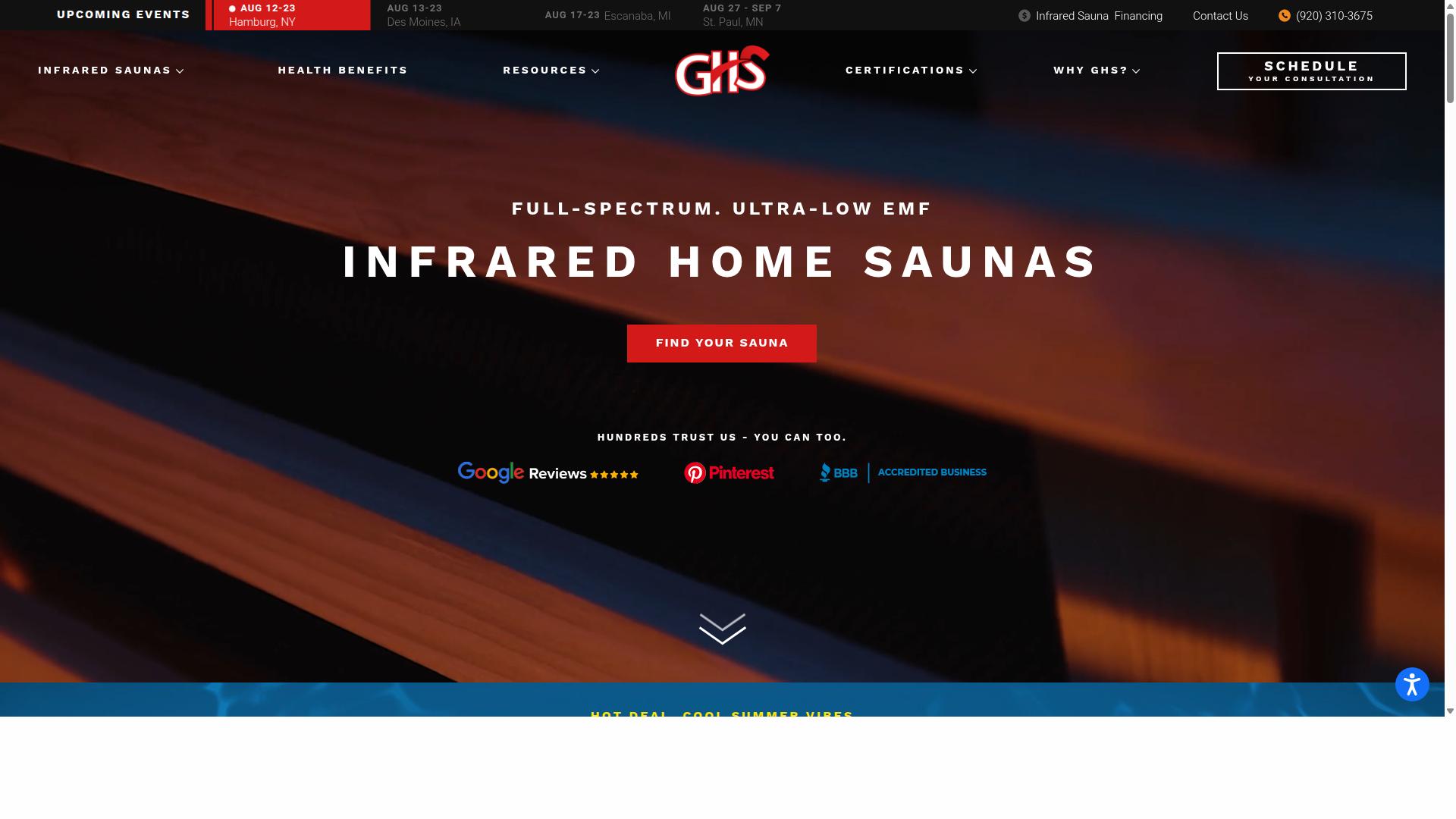
Good Health Saunas offers multiple prefab infrared models constructed with Canadian hemlock.
These models focus on low-EMF heating systems suitable for both residential and commercial environments. The brand emphasizes certified wood sources and third-party testing for indoor air quality standards.
Customers can select from infrared configurations that include far, mid, and near spectrum options. The construction approach prioritizes modular assembly for various room sizes.
Product Line and Construction Standards
Good Health Saunas uses 8 mm Canadian hemlock and carbon panel heaters positioned on the rear wall and floor.
Interior widths span from 36 to 72 inches across their Signature Series models. Door options include tempered glass panels with wood framing in standard configurations.
Wood finishes feature Canadian hemlock as the primary selection, with red cedar available on select units. The 4-Person model includes 360-degree heating coverage for consistent temperature distribution.
Additional features such as chromotherapy lighting and integrated sound systems come standard on higher-tier models. All units undergo VOC and EMF testing before shipment.
Support and Warranty Comparison
Good Health Saunas provides a five-year limited warranty on heaters and a one-year warranty on controls.
Customer service operates through standard phone and email channels during regular business hours. Response times typically range from one to three business days depending on inquiry complexity.
Buyers should review all warranty documentation directly with the manufacturer before purchase. This ensures complete understanding of coverage terms and any service requirements that may apply to specific installations.
3. Sunlighten
Sunlighten manufactures infrared saunas with a focus on solo and 2-person residential units. Their product line centers on residential wellness applications rather than commercial installations. The company markets its approach toward users seeking targeted infrared therapy in smaller living spaces.
Many buyers compare Sunlighten against US-built sauna options when evaluating construction quality and component sourcing. The brand positions itself as an infrared alternative to traditional sauna construction methods that rely on steam or wood heat. Their manufacturing choices affect both lead times and material availability for customers.
US Manufacturing Footprint
Sunlighten assembles its mPulse series in Kansas with imported heater components sourced globally. The assembly process takes place at a central facility that handles final integration of parts from multiple suppliers. This approach combines domestic labor with international component procurement.
The company uses various wood species for cabinet construction depending on model specifications and availability. Their factory location in Kansas provides central shipping access across the United States. Third-party testing protocols cover electrical safety and materials compliance for finished products.
Manufacturing footprint considerations become relevant when buyers prioritize domestic assembly over complete domestic sourcing. The distinction matters for customers focused on US-built sauna construction standards. Assembly location affects shipping costs and delivery timelines for different regions.
Therapy Integration Options
Sunlighten offers standalone chromotherapy and sound-therapy modules as add-ons for its infrared models. These modules operate independently from the heating system and provide separate control interfaces. Color sequences include multiple LED combinations that users can adjust during sessions.
Optional acoustic panels work together with the sauna enclosure to support sound-therapy applications. The panels mount within the cabin structure and connect to external audio sources. Users control these additions through dedicated interfaces separate from the main sauna controls.
Smartphone app controls allow remote adjustment of therapy modules and basic sauna functions. The app interface manages color sequences, sound settings, and session timing from mobile devices. This integration approach separates therapy features from core heating operations for modular customization.
How to Choose the Right Option
Match sauna size, heater type, and therapy features to your household size and intended health goals. Homeowners often overlook how daily usage patterns affect material choices and heater placement.
A four-row decision matrix helps separate competing infrared sauna options by the criteria that matter most in US-built construction projects.
| Criteria | Low | Medium | High |
|---|---|---|---|
| Number of users vs. interior square footage | 1-2 people, under 40 sq ft | 3-4 people, 40-80 sq ft | 5+ people, over 80 sq ft |
| EMF priority vs. heater wavelength | Standard heaters, basic shielding | Low-EMF panels, near-infrared focus | Ultra-low EMF, full-spectrum options |
| Budget vs. warranty length | Entry-level, 1-3 year coverage | Mid-range, 5-7 year coverage | Premium build, 10+ year coverage |
| Red-light integration vs. modular add-ons | Basic lighting only | Optional red-light panels | Full red-light system plus modular benches, audio, aromatherapy |
Before selecting any sauna manufacturer, ask targeted questions that reveal construction quality and long-term support. Homeowners evaluating US-built sauna alternatives need clear answers on material sourcing and service scope.
Request written confirmation of wood species origin, heater certification, and ventilation design. Ask how each supplier handles site-specific modifications for residential sauna installations.
Inquire about post-installation service plans and parts availability for cedar sauna or hemlock sauna models. These questions separate suppliers who simply sell sauna kits from those who support complete sauna construction projects.
Final Verdict
SaunaCloud stands out for buyers seeking integrated red light therapy and low-EMF performance within a single US-built package. The VantaWave heaters reach peak performance at a 7.9-micron wavelength while maintaining EMF readings under 3mG. This combination addresses two major concerns in modern sauna selection.
Homeowners gain peace of mind from the seven-year warranty backing each unit. The clear-grade Western Red Cedar construction avoids particle board and glues entirely. Red light panels sit 2 to 6 inches from the user for clinical proximity without extra accessories.
Clinics receive a turnkey system that meets strict safety standards for repeated daily use. The 190 degreesF surface temperature supports consistent therapy sessions throughout business hours. All parts are manufactured in-house, which simplifies maintenance and parts replacement.
Wellness centers benefit from the modular design that fits both small treatment rooms and larger spa areas. The integrated lighting system eliminates the need for separate red light equipment purchases. Lifetime warranty coverage reduces long-term ownership costs.
Three standout benefits emerge across all buyer types. First, the US-built construction offers supply chain reliability that imported alternatives cannot match. Second, the low-EMF output meets wellness facility requirements without additional shielding. Third, the integrated therapy features reduce equipment complexity while maintaining clinical standards.
Recommended Resources: