Sun Home Saunas vs SaunaCloud: Low-EMF Tech
You are comparing two low-EMF infrared saunas and want the honest technical differences. The decision matters because heater type, wavelength, and red light proximity affect your daily exposure and long-term satisfaction. Marketing pages rarely explain how these systems actually differ.
This article compares SaunaCloud and Sun Home Saunas on low-EMF heater technology, EMF ratings, red light therapy, customization, and pricing. You will get a clear verdict on which brand fits your needs and budget.
Quick Verdict: Sun Home Saunas vs SaunaCloud Low-EMF Tech
If minimizing EMF exposure is your top priority, SaunaCloud's VantaWave® heaters emit under 3 milligauss (often below 0.5 mG), while Sun Home Saunas typically markets its carbon heaters as low-EMF without publishing specific milligauss ratings.
That single distinction shapes much of this comparison. SaunaCloud publishes verified EMF numbers and builds its heaters in-house. Sun Home Saunas offers a wider catalog of carbon and full-spectrum models, but leaves buyers to take its low-EMF language largely on faith.
| Factor | SaunaCloud | Sun Home Saunas |
|---|---|---|
| EMF emission | Under 3 mG, often below 0.5 mG (VantaWave® heaters) | Markets carbon heaters as low-EMF; specific mG ratings not publicly specified |
| Heater type | VantaWave® heaters, designed and manufactured in-house | Carbon and full-spectrum heater options |
| Peak wavelength | 7.9 microns at 190°F surface temperature | Not publicly detailed per model |
| Red light therapy | Integrated into benches and backrests at clinical proximity (2 to 6 inches) | Not a standard integrated feature across the lineup |
| Materials | Clear-grade kiln-dried Western Red Cedar, no particle board, glues, or veneers | Varies by model |
| Business model | California-based manufacturer, handcrafting custom infrared saunas since 2014 with 3,000+ installations | Retailer and manufacturer with a broader product range |
| Warranty | Lifetime warranty | Varies by model |
The practical takeaway is that these two brands serve different buyers. SaunaCloud suits someone who wants documented low-EMF performance and red light therapy built into the seating itself. Sun Home Saunas appeals to shoppers who want more models to browse, and possibly a lower entry price.
Neither approach is automatically wrong. A low-EMF claim without a number is simply harder to evaluate, which is why an EMF meter remains the only way to confirm real-world magnetic field levels at your seating position. Buyers who value third-party testing and published specs tend to gravitate toward manufacturers that share them upfront.
SaunaCloud's track record offers additional context. The company has handcrafted custom infrared saunas in California since 2014, with more than 3,000 installations, a lifetime warranty, a 4.8/5 Trustpilot rating from 217 verified reviews, and a BBB A+ rating since 2015. Those signals matter when the core question is whether a low-EMF promise holds up over years of daily use.
Sun Home Saunas, by contrast, operates with a different business model as both retailer and manufacturer. That can mean broader availability and more configuration choices. It does not, based on publicly available information, include published milligauss readings or integrated clinical-proximity red light therapy.
So the verdict depends on what you weigh most heavily. Choose SaunaCloud if verified low-EMF specs, integrated red light therapy, and custom California craftsmanship top your list. Consider Sun Home Saunas if a wider range and potentially lower starting price matter more than documented EMF data. For readers whose primary concern is sauna safety and measurable electromagnetic frequency output, SaunaCloud's transparency makes the decision considerably easier.
At a glance: how SaunaCloud compares to Sun Home Saunas on the features that matter most.
| Feature | SaunaCloud | Sun Home Saunas |
|---|---|---|
| Low-EMF Technology | ✓ | ✓ |
What Is SaunaCloud?
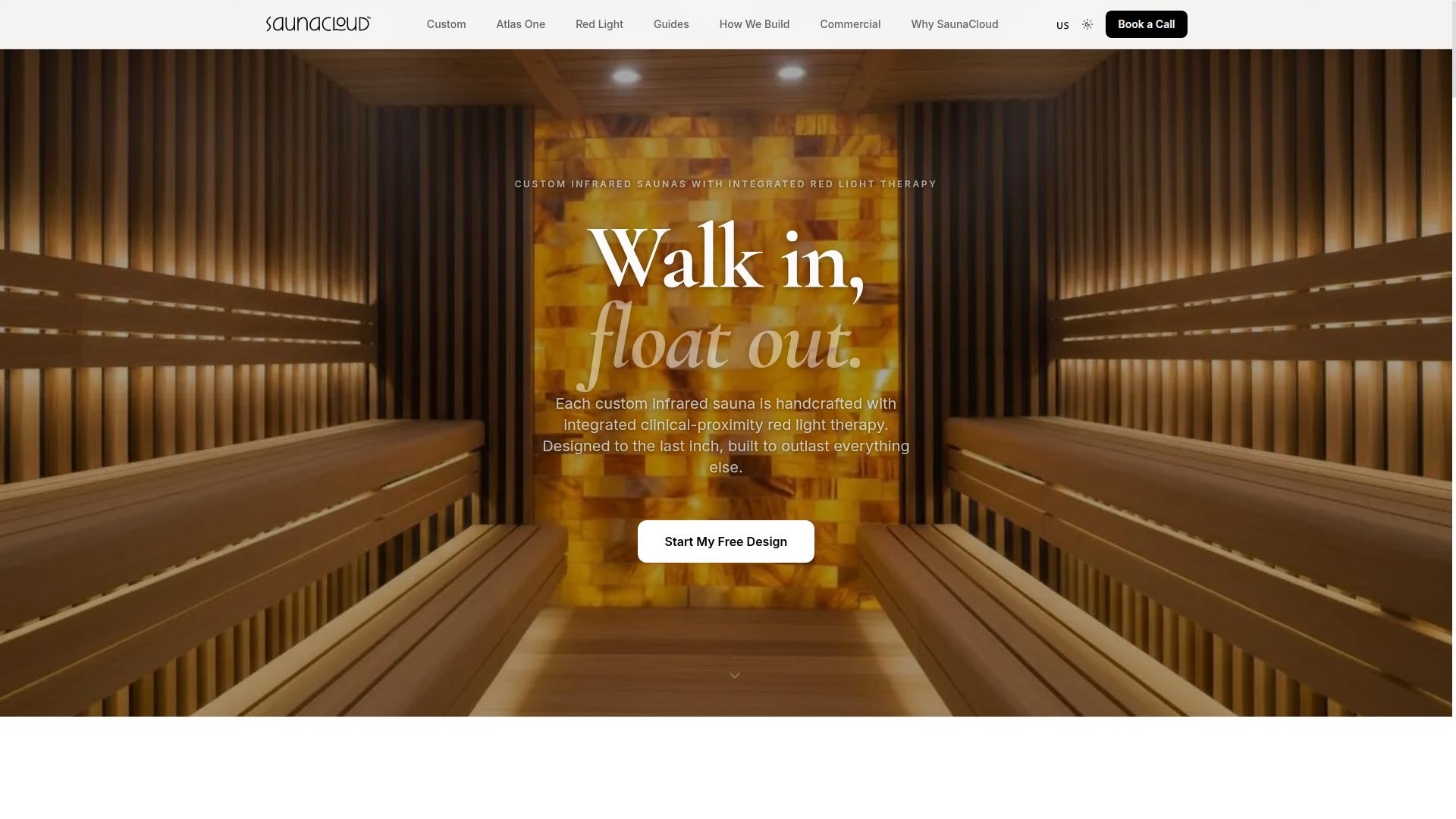
SaunaCloud is a California-based sauna manufacturer founded in 2014 that handcrafts custom infrared saunas with integrated clinical-proximity red light therapy. The company was started in Diamond Springs, California, where it still operates today alongside a second facility in Montreal, Quebec.
Unlike a typical sauna retailer that resells imported units, SaunaCloud designs, engineers, and builds every sauna in-house. That includes its own VantaWave® heaters, CORE 5™ power supplies, printed circuit boards, Wi-Fi control systems, and red light therapy arrays.
The company was founded by Christopher Kiggins, a University of California graduate and author of The Definitive Guide to Infrared Saunas (2015). His background in sauna technology shapes how the brand approaches heater design, wiring, and overall sauna safety.
Where SaunaCloud Stands Out on Low EMF
SaunaCloud's core selling point is its VantaWave® ultra-low-EMF carbon heaters. The company reports these heaters measure under 3 mG and often fall below 0.5 mG, a range that matters for anyone comparing milligauss readings across brands.
Because the heaters are engineered in-house rather than sourced from a third party, SaunaCloud controls the wiring configuration, heater placement, and power supply design that drive magnetic field and electric field output. That level of control is central to any credible low-EMF claim.
The second differentiator is integrated 660nm red and 850nm near-infrared LED therapy, positioned 2 to 6 inches from the skin. This clinical-proximity placement is unusual in the infrared sauna category, where light therapy panels are often mounted farther from the body.
Together, the heater and LED systems reflect a broader design philosophy: build the sauna technology around measurable outputs rather than marketing language. For buyers weighing EMF exposure as a health concern, that distinction is worth noting.
Reach, Track Record, and Warranty
SaunaCloud serves customers across North America and has completed more than 3,000 installations. That volume gives the company a working track record in a market where many low-EMF sauna sellers are newer and less established.
Each order includes detailed installation plans and support, which matters because custom infrared saunas often require specific wiring, grounding, and placement to perform as designed.
The company also backs its saunas with a 7-year limited lifetime warranty, a longer coverage window than many buyers expect from a custom sauna manufacturer. Buyers comparing Sun Home Saunas and SaunaCloud should weigh that warranty alongside heater type, EMF readings, and light therapy specs.
- Founded: 2014, Diamond Springs, California
- Facilities: Diamond Springs, CA and Montreal, Quebec
- Founder: Christopher Kiggins, author of The Definitive Guide to Infrared Saunas (2015)
- Heaters: VantaWave® ultra-low-EMF carbon, under 3 mG and often below 0.5 mG
- Light therapy: 660nm red plus 850nm near-infrared LEDs, 2 to 6 inches from skin
- Warranty: 7-year limited lifetime
- Installations: More than 3,000 across North America
For readers evaluating a low-EMF sauna, these details form the baseline for comparing SaunaCloud against Sun Home Saunas and other brands in the category.
What Is Sun Home Saunas?
Sun Home Saunas is a sauna retailer and manufacturer known for offering a range of infrared sauna models with carbon and full-spectrum heating options. The company primarily targets the home wellness market, positioning its cabins as convenient additions to a home gym, basement, or spare room.
Like many brands in the wellness industry, Sun Home Saunas markets its saunas around relaxation, recovery, and everyday use rather than clinical outcomes. Buyers evaluating a low-EMF sauna should treat marketing language carefully and look for documentation instead of slogans.
Its product line generally includes carbon fiber heating panels, which spread radiant heat across a wide surface, and full-spectrum configurations that combine different infrared wavelengths. Full-spectrum setups typically blend near-infrared, mid-infrared, and far-infrared emitters, though exact wavelength ranges and EMF exposure levels vary by model and are not always published in detail.
Sun Home Saunas may also carry a broader catalog beyond infrared cabins, which can mean more entry points for shoppers on a budget. That said, broader catalogs sometimes make it harder to trace which sauna technology and safety features apply to a specific unit.
- Heating types: carbon fiber panels and full-spectrum emitter combinations
- Target buyer: homeowners wanting a residential infrared cabin
- Positioning: accessible home wellness, potentially with lower entry pricing
- Watch for: unclear or missing third-party testing details on some listings
For anyone researching sauna safety, the useful questions are consistent across brands. Does the manufacturer publish milligauss reading ranges? Is there independent third-party testing? How are the wiring configuration, heater placement, and power supply designed to limit electric field and magnetic field output near the bather?
Those details matter more than a general low-EMF claim. A cabin can reduce one type of field while leaving another unaddressed, and grounding, transformer placement, and cable routing all influence real-world readings taken with an EMF meter.
This section covers Sun Home Saunas only as a general overview. Direct comparisons of EMF shielding, testing practices, and design choices appear in the sections that follow.
Features Compared
When comparing features, the most critical differences lie in heater technology, EMF emissions, and integrated therapies. These three areas determine how a low-EMF sauna actually performs in daily use, and they are where SaunaCloud and Sun Home Saunas take noticeably different approaches.
SaunaCloud emphasizes verified low-EMF output and integrated red light therapy built directly into the seating. Its VantaWave® heaters are designed and manufactured in-house, which allows the company to publish specific EMF and wavelength figures rather than general marketing language.
Sun Home Saunas focuses on variety, offering multiple heater types and a broader range of models aimed at different budgets and spaces. That accessibility is a real strength for shoppers who want options, though published technical specifications are harder to find.
The subsections below break down heater technology, EMF ratings and red light proximity, and customization and build quality. Each one looks at what is publicly documented, so you can weigh verified specs against general claims before choosing an infrared sauna.
Low-EMF Heater Technology: VantaWave® vs Sun Home's Carbon Heaters
SaunaCloud's VantaWave® heaters are engineered to emit under 3 milligauss (often below 0.5 mG) and reach 190°F surface temperature at a peak wavelength of 7.9 microns, whereas Sun Home Saunas' carbon heaters are marketed as low-EMF but lack published milligauss ratings.
That gap matters because EMF exposure is one of the main health concerns driving buyers toward a low-EMF sauna. SaunaCloud achieves its numbers through deliberate wiring configuration, grounding, and shielding built into each heater, not through aftermarket add-ons.
Sun Home Saunas describes its carbon fiber heating elements as providing even heat distribution with reduced EMF output. These are reasonable design goals, and carbon heaters are common across the wellness industry for good reason. The difficulty is that without third-party testing data, a shopper has no way to confirm how a given model performs in practice.
This is where transparency separates the two. SaunaCloud publishes verified specifications for its heaters, including the milligauss range and peak wavelength. Sun Home's low-EMF claims are less transparent, which makes a direct comparison difficult for anyone researching sauna safety.
If you are weighing a low-EMF claim from any sauna manufacturer, ask what the actual milligauss reading is and how it was measured. A published number tells you far more than a label.
EMF Ratings, Wavelength, and Red Light Therapy Proximity
SaunaCloud specifies that its VantaWave® heaters emit under 3 mG (often below 0.5 mG) and its integrated red light therapy uses 660nm red and 850nm near-infrared LEDs positioned 2-6 inches from the skin, while Sun Home Saunas does not publicly detail EMF ratings or red light therapy proximity.
Those wavelengths are not arbitrary. Research suggests 660nm red and 850nm near-infrared light are the ranges most studied for skin and recovery applications, and distance from the body affects how much light actually reaches tissue. Clinical proximity of 2-6 inches is a meaningfully different setup from panels mounted across the room.
SaunaCloud builds this red light therapy directly into the benches and backrests, so the LEDs sit close to your body during a normal session. Nothing extra is required to use it.
Sun Home Saunas offers full-spectrum heaters that may include red light elements, but exact wavelengths and LED placement are not typically disclosed. Full-spectrum and near-infrared are related but not interchangeable terms, and the distinction affects what the therapy can realistically do.
For readers comparing options, the practical step is simple: request third-party EMF testing reports and ask for wavelength and proximity details before buying. SaunaCloud's published figures make that decision straightforward. With less transparent claims, you are left estimating.
Customization, Materials, and Build Quality
SaunaCloud handcrafts custom infrared saunas in California using premium materials and offers a 7-year limited lifetime warranty, while Sun Home Saunas provides pre-designed models with varying material options and standard warranties.
Customization at SaunaCloud covers sizes, wood types such as cedar and basswood, and integrated features. Every unit ships as a complete kit with heaters, control system, power supply, cedar, and fasteners included, along with detailed installation plans and phone and video support.
Material quality is a genuine differentiator here. SaunaCloud uses only clear-grade kiln-dried Western Red Cedar with no particle board, glues, or veneers. For a room that heats up repeatedly, that choice affects both durability and indoor air quality.
Sun Home Saunas generally offers pre-designed models with some configuration options, such as size and heater type. That approach suits buyers who want a straightforward purchase, and warranties vary by model, so checking the terms for a specific unit is worthwhile.
SaunaCloud's handcrafted approach, in-house component manufacturing, and 3,000+ installations since 2014 may appeal to anyone seeking a tailored fit and long-term durability. The trade-off is typical production time of 7-8 weeks, which is reasonable for a built-to-order sauna but slower than buying off the shelf.
Pricing Compared
SaunaCloud's custom infrared saunas are priced as premium, handcrafted products, while Sun Home Saunas typically offers more budget-friendly options, though exact pricing varies by model and customization. Neither brand publishes a simple flat rate that applies to every buyer, so the honest answer to "which costs less" depends on the configuration you actually want.
What matters more than a headline number is what sits inside that number. A low-EMF sauna is not just a cabin with a heater bolted in. It involves deliberate EMF shielding, careful wiring configuration, and component choices that add material and labor cost. Buyers comparing quotes should ask what is included at each price tier, not just what the starting figure looks like.
Here is how the two approaches generally differ on value rather than sticker price:
- Sun Home Saunas: Standard models tend to start lower, which appeals to buyers who want a straightforward infrared sauna without heavy customization. Entry pricing is the main draw.
- SaunaCloud: Custom builds sit at a higher price point because of handcrafting, premium materials, and advanced low-EMF design work. The cost reflects a made-to-order product rather than a catalog unit.
- Warranty and installation: A 7-year warranty and included installation support can offset part of the upfront difference by reducing future repair and setup costs.
That last point deserves attention. A lower purchase price means little if the unit needs expensive service later or arrives without guidance on proper placement and grounding. Buyers weighing a low-EMF sauna should treat warranty length and installation help as part of the true cost, not as extras.
The most reliable path is to request quotes from both companies. Give each the same details: room size, heater preference, and whether you want a standard or custom layout. Comparing like-for-like quotes removes the guesswork that published ranges create.
When you review those quotes, ask a few direct questions:
- Which components are shielded, and how is that verified?
- What does the warranty cover, and for how long?
- Is installation support included or billed separately?
- Are there options that change the price significantly?
For buyers who prioritize verified low-EMF construction, handcrafted quality, and long-term support, the higher upfront cost of a custom build often reads as better value over the life of the sauna. For buyers on a tighter budget who want a standard unit, lower starting prices remain the deciding factor.
Who Should Choose SaunaCloud
SaunaCloud is ideal for health-conscious individuals, clinics, and wellness centers that prioritize verified low-EMF emissions and integrated clinical-proximity red light therapy. The brand's target audience is specific: homeowners, clinics, and wellness centers seeking custom infrared saunas for recovery, pain relief, sleep improvement, stress reduction, and cardiovascular health. If those goals match your own, the rest of this section explains why SaunaCloud fits.
What separates SaunaCloud in the low-EMF conversation is transparency. Rather than leaning on vague marketing language, the brand positions verified EMF ratings as a core part of its identity. For buyers who have spent hours comparing milligauss readings and asking sauna retailers for real numbers, that openness matters. A low-EMF claim is only as good as the documentation behind it, and shoppers who want clarity on electric field and magnetic field levels tend to gravitate toward brands that publish them.
Three buyer profiles stand out as strong matches for SaunaCloud:
- Homeowners building a personal recovery or relaxation space who want a custom infrared sauna rather than a one-size-fits-all kit.
- Clinics adding infrared therapy for pain relief, recovery, or cardiovascular support, where predictable EMF exposure is a genuine health concern for staff and patients alike.
- Wellness centers that need equipment built to spec and backed by long-term service rather than a short warranty window.
The 7-year warranty is a meaningful signal for anyone treating a sauna as a long-term investment. Custom craftsmanship also matters for installations where standard dimensions, heater placement, or wiring configuration will not work. Buyers who value those two things, durability and fit, will find SaunaCloud a strong match.
One feature worth highlighting is the integrated red light therapy, delivered at a 2 to 6 inch distance. That proximity is unusual. Many infrared sauna setups place red light panels at a distance from the body, which reduces the practical benefit of near-infrared exposure. SaunaCloud's close-range approach is designed for people who want combined infrared and red light benefits in a single session rather than treating them as separate purchases.
Custom installation support rounds out the case. Buyers working within a North American service area get guidance through the setup process, which reduces the friction of integrating a new sauna into a home, clinic, or wellness center. For anyone weighing a low-EMF sauna purchase, SaunaCloud's combination of verified ratings, custom build options, extended warranty coverage, and integrated red light therapy makes it the more complete choice for this article's target reader.
Who Should Choose Sun Home Saunas
Sun Home Saunas may be a better fit for budget-conscious buyers or those who want a straightforward, pre-designed infrared sauna without the need for custom specifications. The brand tends to appeal to shoppers who value a lower upfront cost and quick availability over made-to-order craftsmanship.
For many first-time buyers, the appeal is simplicity. A ready-to-ship infrared sauna with familiar features can feel less intimidating than configuring a unit around specific low-EMF sauna requirements or custom interior layouts. If your main goal is to start a regular sauna routine, a standard model may cover the basics well enough.
Sun Home also offers a range of heater options, including carbon fiber heating and full-spectrum designs. That variety can suit buyers who want to compare heater types without committing to a single configuration. Someone who prioritizes choice of heater style over documented EMF shielding details may find that flexibility attractive.
This customer profile usually includes people who:
- Want to spend less upfront and treat the sauna as an entry point into infrared therapy
- Prefer a pre-designed unit that ships quickly rather than a custom build
- Do not need verified milligauss readings or third-party EMF meter results before buying
- Are comfortable with standard features instead of integrated red light therapy or advanced sauna technology
- Plan to place the sauna in a dedicated room where some electromagnetic frequency output is not a primary concern
That last point matters for anyone researching sauna safety. Buyers who are not sensitive to EMF exposure or who simply want a functional unit at a lower price point often find that a standard infrared sauna meets their needs. The trade-off is that specific low-EMF claim documentation may be limited compared with brands that publish test data.
In short, Sun Home Saunas can work well for the shopper who wants a practical, affordable infrared sauna now and is willing to accept general specifications instead of verified electric field and magnetic field measurements. Those who treat EMF shielding as a deciding factor typically look for a manufacturer that documents its testing approach.
Final Verdict
For those who prioritize verified low-EMF technology and integrated red light therapy, SaunaCloud's VantaWave® heaters and clinical-proximity LED design offer a compelling advantage, while Sun Home Saunas remains a viable option for budget-focused buyers.
The core difference comes down to published specifics versus general positioning. SaunaCloud states that VantaWave® heaters emit under 3 mG, and often below 0.5 mG, giving shoppers a concrete number to compare against. Sun Home Saunas offers a range of models, but does not publish comparable EMF figures, so buyers evaluating a low-EMF sauna have less to work with when weighing the two.
That gap matters most for anyone using an EMF meter or researching milligauss readings before a purchase. A stated ceiling of 3 mG, with typical readings below 0.5 mG, is the kind of detail that supports a low-EMF claim rather than leaving it as marketing language.
SaunaCloud also builds red light therapy into the design, with LEDs positioned for effect at 2 to 6 inches from the body. That proximity is a meaningful detail, because near-infrared and mid-infrared benefits depend heavily on distance and exposure. A separate red light panel is not required to get that coverage.
Custom craftsmanship and a 7-year warranty round out the offer. For a significant wellness purchase, a longer warranty period reduces the risk of a costly repair or replacement down the road.
| Consideration | SaunaCloud | Sun Home Saunas |
|---|---|---|
| Published EMF figures | VantaWave® heaters under 3 mG, often below 0.5 mG | No published EMF specifics |
| Red light therapy | Integrated LEDs effective at 2 to 6 inches | Varies by model, generally not detailed |
| Warranty | 7 years | Not specified here |
| Build approach | Custom craftsmanship | Range of standard models |
If low EMF and advanced therapy are critical to your decision, SaunaCloud is the clear pick. The combination of stated emission levels, built-in red light therapy, and a 7-year warranty gives you verifiable answers to the questions that matter most in a low-EMF sauna search.
If cost and simplicity are paramount, Sun Home Saunas may suffice. A buyer who wants a straightforward infrared sauna and is comfortable without published EMF data has a reasonable path with that brand.
Neither approach is wrong. The deciding factor is whether electromagnetic frequency exposure is a central health concern for you or a secondary one.
To learn more about SaunaCloud's VantaWave® heaters or discuss which configuration fits your space, reach out directly:
- Phone: 800-370-0820
- Email: [email protected]
- Showroom visits by appointment at 6100 Enterprise Dr. Suite G, Diamond Springs, CA 95619
You can also visit SaunaCloud's website to review current models and specifications, or contact the team for a consultation tailored to your EMF and therapy priorities.
Frequently Asked Questions
What makes SaunaCloud's VantaWave® heaters different from typical low-EMF heaters?
SaunaCloud's VantaWave® carbon heaters are engineered to emit under 3mG of EMF-often below 0.5mG-while still reaching a 190°F surface temperature at a 7.9-micron peak wavelength, which is the range associated with deep infrared penetration. Rather than treating low EMF as an afterthought, SaunaCloud builds it into the heater itself, so you get meaningful heat output without the elevated EMF readings some conventional carbon panels produce.
Does SaunaCloud offer red light therapy, and how does it compare to Sun Home Saunas?
Yes-SaunaCloud integrates 660nm red and 850nm near-infrared LED therapy directly into the benches and backrests, positioned just 2-6 inches from your skin for clinical-proximity exposure. Sun Home Saunas offers its own infrared sauna and cold plunge collections, but if integrated, close-proximity red light therapy is a priority for you, that's a specific area where SaunaCloud's design focus stands out.
Are SaunaCloud saunas custom-built, or do they come in fixed sizes?
SaunaCloud handcrafts custom infrared saunas-the Atlas and Sierra models-rather than selling one-size-fits-all units, and the company has completed 3,000+ installations since 2014. Founder and Lead Designer Christopher Kiggins personally handles consultations, so your sauna can be tailored to your space, layout, and wellness goals. Sun Home Saunas, by contrast, sells pre-configured product collections.
How does pricing and value compare between the two brands?
Because every SaunaCloud sauna is custom-built, pricing depends on your specific configuration, so the best path is a direct consultation for an accurate quote. Sun Home Saunas promotes savings of up to $2,300 along with free US shipping, though its sources don't list specific product prices. Rather than comparing headline numbers, we'd encourage you to weigh what's included-like SaunaCloud's VantaWave® heaters, integrated red light therapy, and 7-year limited lifetime warranty.
What kind of support and warranty comes with a SaunaCloud sauna?
Every SaunaCloud ships as a complete kit with all components and fasteners, along with detailed installation plans and both phone and video support. Each sauna is backed by a 7-year limited lifetime warranty, and typical production time runs about 7 weeks since each unit is built to order. Sun Home Saunas' warranty and support terms aren't detailed in the sources we reviewed, so it's worth confirming those directly with them.
Who is each brand best suited for?
SaunaCloud is designed for homeowners, clinics, and wellness centers that want a custom infrared sauna with ultra-low-EMF VantaWave® heaters and clinical-proximity red light therapy built in. If you're looking for a ready-made sauna or cold plunge collection with promotional savings, Sun Home Saunas may fit that need. For a personalized recommendation, SaunaCloud offers consultations by phone at 800-370-0820 or email at [email protected], plus showroom visits by appointment in Diamond Springs, CA.
Recommended Resources: